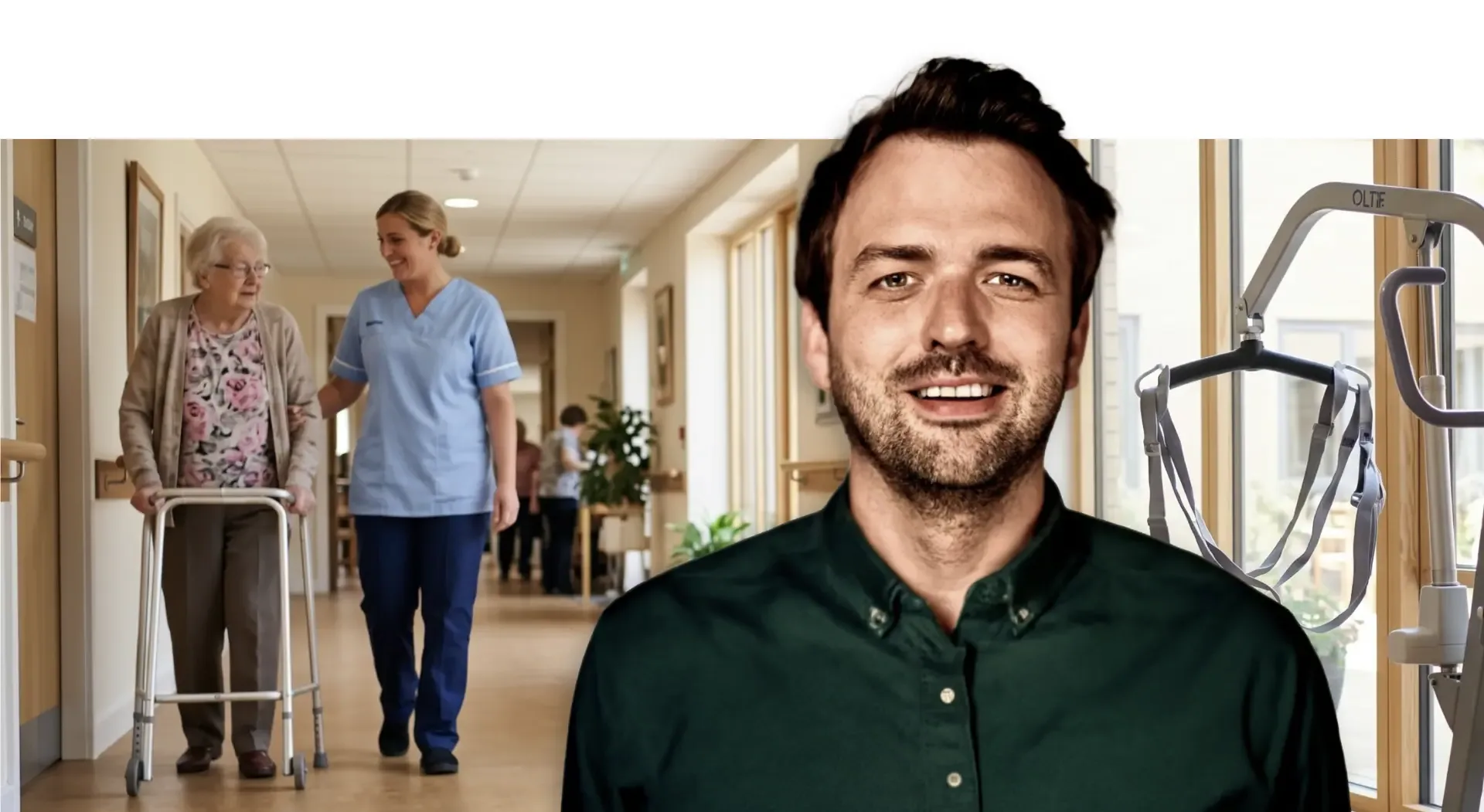
A hundred days. That is not long enough to fully grasp a sector, but it is long enough to stop making assumptions.
Since joining Quodoc, I have mainly done what seemed most logical: watch and listen. Dozens of conversations with management, head nurses, and maintenance teams. Visits to residential care homes in cities and villages, large and small. Conferences, trade fairs, and casual coffees at reception that turned into guided tours.
What I saw surprised me. Sometimes pleasantly, sometimes less so.
Below are eight findings: four personal observations about what life feels like in a residential care home, and four professional ones about how things run. The second four almost all touch on the same underlying theme: asset management in residential care. Not because that is what I sell, but because it surfaced spontaneously every single time.
1. Care unconditionally comes first
Whatever goes wrong behind the scenes – a patient hoist breaking down, a supplier failing to show up, a schedule falling apart – the resident notices nothing. Human care and the well-being of the people living there always come first. Without discussion, without hesitation.
I have witnessed this first-hand multiple times. A nurse who politely excuses herself midway through a conversation with me because the resident in room 14 needs her. And returns five minutes later as if nothing happened.
That is not a minor detail. It is the lens through which you must view every proposal in this sector. Anyone coming in with a solution that costs time rather than saving it can turn straight back round. And rightly so.
2. Always a warm and welcoming reception
Throughout my career, I have seen many sectors from the inside. Nowhere do you get through the door as quickly as here. The doors are open, both literally and figuratively. You are handed coffee before you've even taken off your coat, and given a tour before you've even asked.
That hospitality is not commercial politeness. It is the professional instinct of people whose entire day revolves around welcoming others: residents, families, GPs, volunteers, suppliers.
Practical advice for anyone looking to make a difference in this sector: pay them a visit. Don't just call, email, or demo through a screen. Stand where the action is: in the corridor, by the storage room, with the maintenance team. You will learn more in one visit than in ten web meetings.
3. Innovation is on the agenda, but stalls
At every conference I attended, at least one session was dedicated to digitalisation. In every meeting with management, the topic came up spontaneously. The willingness is there, the urgency is felt, the buzzwords are familiar.
And then? Then putting it into practice turns out to be the real challenge. There is no time to lead a project. There is no clear owner. There are three other priorities that seem more urgent. And so the item gets pushed to the next agenda.
What does work, I saw in a residential care home that didn't start with a massive digitalisation plan, but with one department and one category of equipment. Small enough to complete within a month, visible enough to spark internal momentum. Start with one thing you can finish before the summer. That is infinitely more valuable than a master plan that gathers dust.
4. Technology is still too often seen as a competitor to the care budget
This is the finding that stayed with me the most. In many conversations, the same unspoken calculation emerges: every euro spent on technology is a euro not spent on care.
That reflex is completely understandable. When your budget is tight and your staff are on their knees, you would rather spend that money on hands at the bedside.
Except the maths doesn't add up. Technology serves that care. A nurse who no longer spends half an hour searching for a blood pressure monitor wins back that half-hour for their residents. Calculate just once how many hours a week your team spends searching, calling, and chasing things up. That figure isn't an IT figure. It's a care figure.
5. Structural staff shortages, and a continuous search for efficiency
Work pressure is high. That's not news; it has been in the headlines for years. What did strike me, however, is how actively solutions are being sought. Nobody is resigning themselves to it. Everywhere, rotas are being adjusted, task differentiation is being trialled, and efforts are being made to separate logistics from care.
Yet this search is often based on gut feeling because the data is missing. People suspect time is being wasted, but they don't know for sure.
Therefore, carry out a measurement before you change anything. Have one team track for a week how many times they have to search for something that should be readily available. That list is usually confronting enough to accelerate a decision that might otherwise have stalled for another year.
6. Asset management in residential care lacks overview and predictability
This is where almost everything converges. Beds, patient hoists, wheelchairs, mattresses, medical equipment, fridges, IT equipment: together, they represent a substantial portion of a residential care home's assets. And yet, asset management in residential care is rarely structured in an organised way.
Where is device X? Has it been inspected? When is the next maintenance due? Who was the last person to work on it? In many care homes, the answer lives in one person's head. And one day, they will go on leave, or resign.
The hardest part isn't even the overview; it's the predictability. Without visibility over the maintenance schedule, you are constantly caught off guard, and surprises are costly. Start with the equipment where a breakdown has an immediate impact on a resident. That is your quickest path to peace of mind.
7. Operational management still relies on paper and Excel
Daily schedules on a printed sheet. Tasks on a whiteboard. An Excel spreadsheet with maintenance dates maintained by one person and copied by three others. I have seen them all, and often in care homes that otherwise run very smoothly.
Paper and Excel aren't foolish. They work, until they don't: during sickness, during an expansion, during an audit, or when a new employee joins who doesn't know the system behind the system. Then it proves prone to error, and above all: not shareable.
The test is simple. Take one process – this year's inspections, for example – and ask yourself whether someone else could take it over tomorrow, solely based on what has been documented. If they can't, then that process doesn't reside in your organisation, but in someone's head.
8. Budget allocation for supporting technology is sub-optimal
Finally, the most challenging one. Investments in supporting technology are booked as a cost, and therefore judged as a cost. Whereas in practice, it is a lever to keep care affordable and manageable in the long term.
The difference lies in the question you ask when making the decision. Not: what does this cost? But: what does it cost us today not to have this? In search time, in emergency repairs, in prematurely written-off equipment, in paperwork during an inspection.
Put those two figures side by side in your next budget meeting. In the cases I have seen over recent months, that comparison surprisingly often tipped in favour of investing. Not because technology is so wonderful, but because chaos is so expensive.
One hundred days on
My main conclusion after these first hundred days: the sector lacks neither goodwill, craftsmanship, nor common sense. What is missing is time to reflect on the things running in the background.
I would love to help with that, and the best way to do so remains: dropping by and listening.
We are happy to make time for an online call, a demo, or a visit to your office.
Contact us at roel.engelen@quodoc.com or on +32 478 45 15 25. No strings attached.