A care bed that won't lower. A patient hoist running stiffly. A TV that suddenly has no picture. Minor incidents that occur in every residential care home. More often than you would think. And it usually isn't the fault itself that takes up the most time. It is the journey from report to repairer.
Because how are incidents reported in a residential care home today? Via a sticky note on the counter. A phone call to someone who is currently in a meeting. A note left at reception. Or a list that isn't reviewed until the next morning, when the morning care routine is already over.
That costs care staff time they would much rather spend with their residents. Because that is where their heart lies. Not in the administration of things that aren't working.
What gets lost along the way
In that scenario, the maintenance team rarely gets the full story. 'There's a broken bed on the second floor.' Which bed exactly? In which room? What is actually wrong: the motor, the handset, a castor?
So the technician comes to inspect it, finds he has the wrong spare part, and heads back. Two trips for a single fix.
Meanwhile, duplicate reports pile up. Three people report the same fault, or three people report different issues with the same device. Nobody knows what has already been logged, because there is no single place where it is recorded.
And then there is the fault that gets overlooked. Not out of unwillingness, but because one note slipped underneath another. Days later, a patient hoist is still out of service while care staff need it. Equipment that cannot be used at the exact moment it needs to work.
The consequence for the maintenance department: a day spent reactively improvising instead of planning. If you spend all day putting out fires, you never get round to preventive maintenance. Which causes even more fires. And so the vicious circle continues.
Why an extra form or an extra inbox doesn't help
The standard reflex is a central shared inbox, an Excel spreadsheet, or a paper fault report form in the staff room. Logical on paper. But in practice, it creates just enough friction to make the solution fail.
Because care staff are at the bedside, wearing gloves, between two residents. The laptop is three doors down the hall. Anything requiring them to walk away, log in, and fill in an 'issue description' field is postponed until after the round. And after the round, something else comes up.
Moreover, an inbox doesn't solve the identification issue. Someone typing 'bed room 214' doesn't provide a serial number, brand, year of manufacture, or maintenance history. That information isn't in the care worker's head, nor should it be. It's right on the device.
And the third shortcoming: email and Excel don't have a memory tied to an asset. Their memory is tied to a date. As a result, nobody ever notices that the bed in room 214 has broken down for the fourth time this year. Which is precisely the information you need to decide whether to repair it once more or simply replace it.
Every asset its own Virtual Passport
In Quodoc, every device receives its own Virtual Passport. Beds, patient hoists, wheelchairs, bathtubs, fridges, TVs: anything that can carry a label gets an identity in the system. If desired, this includes infrastructure as well, from light switches to garage doors.
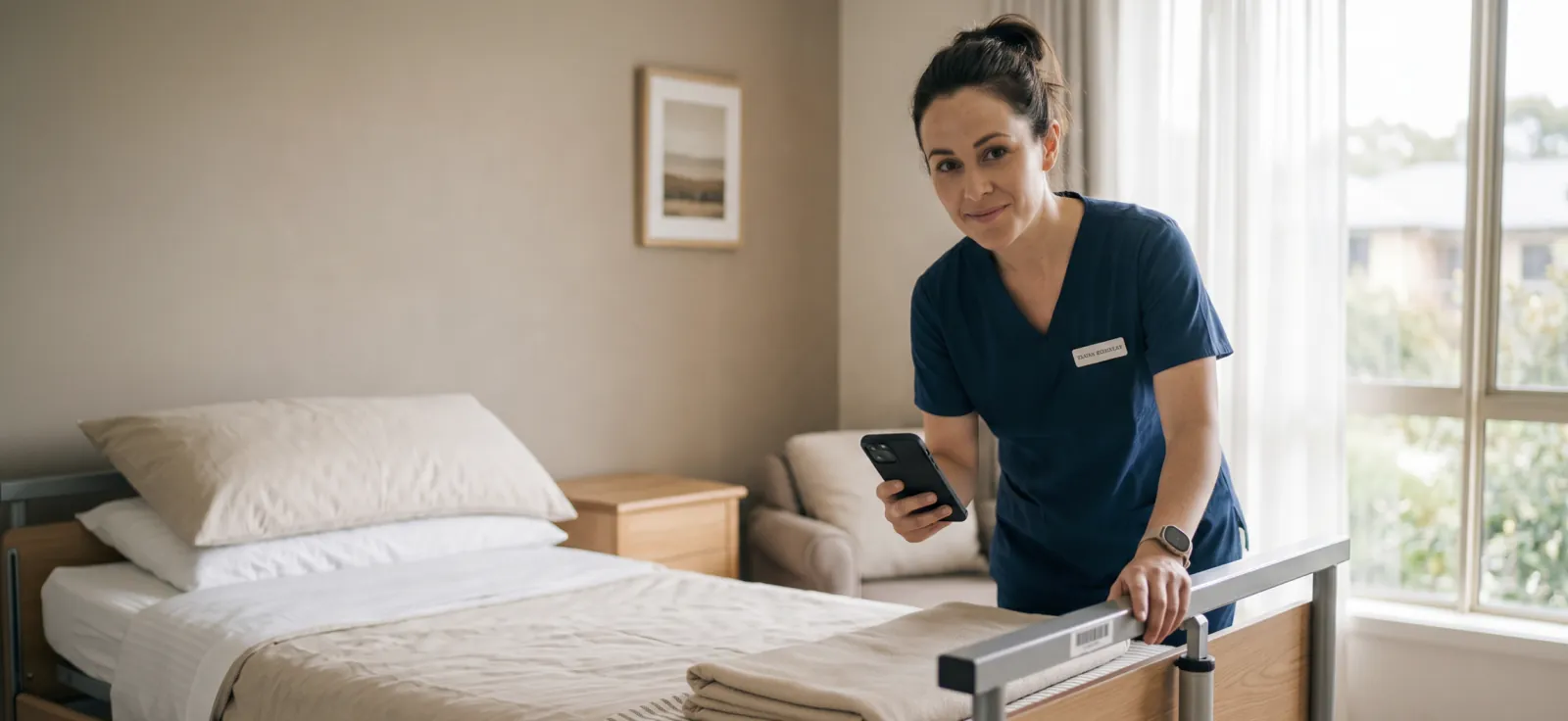
Reporting happens directly at the asset itself. Scan, indicate what's wrong, optionally add a photo, submit. Under twenty seconds.
The care worker scans the label with their smartphone, indicates what is wrong, optionally adds a photo, and submits. No phone call, no handwritten note, no walk to reception.
At the other end, a 'ticket' arrives with the maintenance team and is automatically scheduled. Complete with the correct equipment type, the precise location, and an accurate description. The technician knows before leaving what tools and parts to bring along.
That ticket is fully traceable: who was it assigned to, who is handling it, what is the status, when was it resolved? The person who reported it can see that their request was received and when it has been completed. That alone eliminates the majority of duplicate reports.
And because everything remains linked to the passport of that specific asset, its history builds up automatically. Four interventions on the same bed in twelve months is no longer an anecdote, but a clear entry in a log.
Opt for 'Knowledge, Control, and Ease'
That is the logic behind the three pillars on which Quodoc's Virtual Passport is built.
Knowledge. Or simply knowing. Knowing what you have, its status, where it is located, and when the next maintenance check is due. Not inside the head of a single employee retiring next month, but securely in the system.
Control over your organisation. Ensuring your assets remain in top condition, are inspected on time, and are where they belong. A fault that is reported faster means an asset that is back in service sooner.
Ease. Because your processes run automatically: from reporting and ticketing to scheduling and sending inspection reports to the right recipients. We call it letting go. And you can only let go with confidence when you know everything is under control.